
liminal - Imbolc & Brigid
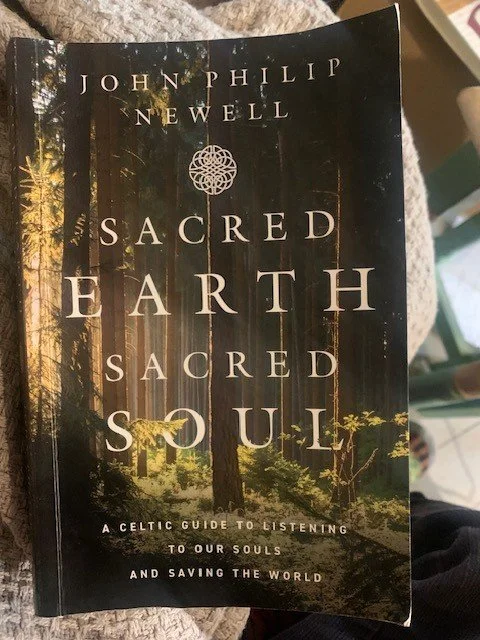
‘Sacred Earth, Sacred Soul’ by John Philip Newell inspired me to write something on the liminal and Brigid and Imbolc
I love thinking about the liminal, the space in the peripheral of perception, the point where ‘the veil is thin’. As I recently read about Brigid in ‘Sacred Earth, Sacred Soul’ by John Philip Newell, about how she represents the threshold, the liminal space, I felt a tug to write something about her and the ‘threshold.’
Brigid is not so much a goddess as she is a symbol, an expression of how the ancients of Ireland and the British Isles articulated the understanding of nature. Brigid is an ancient myth describing the threshold place, representing the beginnings of spring - the time of renewal as new life surges up after months of ice and cold. Hope rising like fresh green shoots pushing through the hardened ground from the dark winter months.
I first came across the term ‘liminal’ years ago when I was studying Art Psychotherapy. It was describing people caught in liminal spaces due to trauma. It resonated with me then as I considered how many people (not only trauma-based) do not quite fit into the ‘accepted’ forms of community, those who seem to float around the edges of polite society. The ones that dwell in the margins, that are called ‘marginalised.’
Liminal: that barely perceptible moment where day slides without strain into darkness, where morning light unfurls from night to day. The portal into another realm; the membrane from one boundary to another. The threshold place where depths of winter begin to show change. Snowdrops under trees, days becoming longer as the slight nod to spring grows stronger with the most nuanced of discernment.
In the Celtic world the 1st of February is a combination of the two celebrations: Imbolc and Brigid’s Day. The two intrinsically tied together as they mark the beginnings of spring. Imbolc celebrations honour the Celtic goddess Brigid, known in Ireland as La Fheile Bride (St Brigit’s Day). She is a pre-Christian deity and Celtic saint. ‘Brigit is the saint who loves the earth and who reveals the sacredness of the feminine.’ (John Philip Newell) She is both a doorway between pre-Christian and Christian, and seen as the threshold between winter and spring.
Imbolc is one of the four Gaelic seasonal festivals alongside Bealtine, Lughnasadh and Samhain. The Celtic year is divided into two halves: Samos (summer) and Giamos (winter) with Imbolc in the middle of Giamos, halfway between winter solstice and spring equinox. It is the point at which decrease turns to increase, the point of transformation, the first day toward spring.
Brigid is primarily linked to the elements fire and water. She is associated with ‘the return of the light’ at the festival of Imbolc, where ancestors celebrated with the lighting of fires. Brigid, keeper of the sacred flame and the holy wells. She is associated with poetry, wisdom, generosity, and healers. Brigid means ‘exalted one’. It comes from the Sanskrit word ‘Brhati’, meaning ‘high’, derived from the root ‘bergh,’ meaning ‘to rise’.
Brigid was a primordial goddess of the Britons and the Celts. It is thought that she is one of the earliest female deities recognised by European ancestors, with evidence of her beginning in the Neolithic era, prior to the arrival of the Romans. Deeply rooted in Irish and Scottish pagan mythology, she became known as St. Bride in Scotland and England. A woman, who possibly changed her name to Brigit, was said to have been born of a Druid and a Christian and came from Ireland to The Hebrides, which are named after her. Mythology says she was carried from the Isle of Iona to the Inner Hebrides, and to Bethlehem on Christmas Eve. She reportedly died in her monastery in 535 AD.
Imbolc and Brigid sit at the threshold of winter to spring, coming from darkness to light.
Darkness is the mystery, the place of the sacred, the set apart. The part in a story where the hero leaves the fold, travelling out to the wilderness, the place of separation. It is the winter, night time, of the Lower world, the deep.
Light is the daylight, celestial heavens, the cosmos, the tribe. That which is of the Upper world. The tribe in contrast to the wilderness. It is the profane.
And then there is the place between. The portal, the marginal, the place on the fringe. If we grab too intensely, we will lose it, that barely perceptible moment of profound change. The spark of inspiration.
Latin – in limine meaning at the ‘threshold.’ The liminal space as opposed to the fixed solid structure. Opposite to an inflexible, unchangeable presence there is fluidity, a flowing stream of life, a living water of movement and change.
The flow, the portal, the life flow within us and within all things, where the sacred feminine and sacred masculine conjoin in harmony. At the heart of heaven and earth is a dance, a place of movement, and when they move in love, the marriage of heaven and earth, the intermingling of the divine and the human, we thrive. Brigid represents that place standing at the doorway, the threshold encounter. Inviting us to look at the sacred of everyone, including the stranger, the foreigner, and the other, and in the depths of our own being too. The sacred and profane, the meeting of the two. Finding and expecting to find the sacred beyond the boundaries of one culture, one religion or nation, awakening to the holy in the other.
The Celtic world bridged the ancient Druid practice deeply connected to the earth with the Christian faith that connected with the heavens. John Philip Newell says,
‘[Brigid] points to sacredness that is within as well as beyond us, that is embodied in earth but not bound by form, a sacredness that is beneath our feet yet higher than the highest heaven, the two forever one both expressing the divine essence of life.’
A place of beautiful reciprocity. Druid means oak-knower or bearer of oak wisdom. They were deeply rooted into the earth, the intimate relationship between humanity and the earth.
Imbolc means “in the belly.” This is where new life is to be found, in the belly of the earth, in the belly of the feminine, in the belly of the human soul. In the place of ambiguity, the stirrings of new life. The liminal space between the womb of the universe and what is trying to come into being, the waters break as we give birth from the unseen to the seen. Brigid is associated with the stirrings of new life from these depths.
The earth as the feminine, the above as the masculine. Both are needed; different energies that form a whole. Winter invites us inwards, into stillness, shadow, listening. The Earth draws us down into the soil, where seeds are planted and creation takes place, in the hidden, the unseen. To gather strength for the journey upwards, to rise and bask in the warm glow of the sun.